Every startup begins with a simple idea. The first goal is usually to build a working product, test it with users, and see whether the market needs it. At this stage, speed is important. Founders want to launch quickly and avoid spending too much money before validation.
But once the product starts growing, new challenges appear. More users sign up. More data enters the system. More transactions happen. More reports are generated. More support requests come in. If the application was not planned properly, it may become slow, unstable, and difficult to maintain.
This is where scalable application development becomes important. Scalability means the software can grow with the business. It can handle more users, more data, and more activity without breaking the user experience.
For startups, indie app developers, software companies, and internet entrepreneurs, scalability does not mean building a huge enterprise system on day one. It means making smart technical decisions that allow the product to grow step by step.
What Does Scalability Really Mean?
Many people think scalability means using expensive servers or complex cloud architecture. But scalability is more than infrastructure.
A scalable application should be able to handle growth in different areas. It should support more users, more database records, more files, more API requests, more background jobs, and more team members working on the code.
Scalability also means the product can add new features without becoming messy. If every new feature creates bugs in old features, the system is not scalable from a development point of view.
A scalable app is not only fast. It is also maintainable, organized, secure, and flexible.
Start With a Clean Architecture
The foundation of scalable application development is clean architecture. Even a small MVP should be structured properly.
This does not mean the first version needs microservices or advanced DevOps. It means the code should be organized in a way that is easy to understand and improve.
For example, authentication, user management, payments, notifications, reports, and admin features should not be mixed randomly. Each major function should have a clear place in the codebase.
A clean architecture helps developers add new features faster. It also reduces the chance of breaking existing workflows. When the product grows, the development team can improve specific modules without rewriting the entire system.
Choose the Right Database Design
Database design plays a major role in scalability. Many performance problems begin with poor data structure.
A startup may start with a small number of users, but over time, the database may contain thousands or millions of records. If the tables or collections are not designed properly, reports can become slow, searches can fail, and updates can create problems.
The database should be designed around the real business workflow. Important relationships should be clear. Indexes should be used where needed. Data should not be duplicated unnecessarily. Reports should be considered during the early planning stage.
For example, a SaaS product may need to track users, teams, subscriptions, invoices, activity logs, and settings. A healthcare platform may need to manage patients, doctors, appointments, records, prescriptions, and reports. These systems should be planned carefully because they may handle sensitive and high-volume data.
Good database design helps the application stay stable as it grows.
Build APIs That Can Grow
Modern applications often use APIs to connect web apps, mobile apps, admin panels, third-party tools, and external services. If the API is poorly designed, the entire product can become difficult to scale.
A scalable API should be consistent, secure, and well-documented. It should use clear endpoint names, proper request validation, meaningful error messages, and reliable response formats.
API versioning is also useful when the product grows. It allows the development team to improve the API without breaking old mobile apps or existing integrations.
For startups planning mobile apps or multi-platform products, API-first development is a smart approach. It keeps the backend organized and allows different frontend applications to use the same core system.
Use Caching to Improve Performance
As traffic grows, some parts of the application may receive repeated requests. For example, users may frequently load dashboards, product lists, settings, reports, or public pages.
Caching helps reduce unnecessary server and database load. Instead of calculating or fetching the same data again and again, the system can store temporary results and serve them faster.
Caching can be used at different levels. It can be used in the browser, application, database, CDN, or server layer. The right caching method depends on the product.
For example, a content-heavy website may benefit from page caching and CDN. A SaaS dashboard may benefit from caching selected report data. An eCommerce app may cache product categories or popular products.
Caching should be used carefully. If the data changes frequently, the system should know when to refresh the cached data. Poor caching can show old or incorrect information.
Handle Background Jobs Properly
Not every task should happen immediately during a user request. Some tasks take time and should run in the background.
Examples include sending emails, generating reports, processing uploaded files, syncing data, sending notifications, creating backups, or calling third-party APIs.
If these tasks run directly while the user is waiting, the app may feel slow. Background jobs allow the app to respond faster while heavy work continues separately.
Queue systems are commonly used for background processing. They help manage tasks in an organized way. If many users trigger tasks at the same time, the queue can process them step by step.
For growing startups, background jobs are very useful because they improve user experience and reduce server pressure.
Plan Infrastructure Step by Step
Scalable infrastructure does not mean spending heavily from the beginning. A startup can begin with a simple server or managed cloud service. As traffic grows, the infrastructure can be improved.
The product may later need load balancing, separate database servers, object storage for files, CDN for static assets, automated backups, monitoring tools, and scaling rules.
The important thing is to avoid choices that block future growth. For example, file uploads should not be stored only inside a single server if the app may later run on multiple servers. User sessions should be planned in a way that supports scaling. Logs and backups should be handled properly.
A practical infrastructure plan helps the product grow without panic.
Security Must Scale Too
As an application grows, security risks also increase. More users and more data mean more responsibility.
A scalable application should include secure authentication, role-based access, strong password handling, encrypted communication, input validation, audit logs, and regular backups.
In some industries, security and compliance are even more important. Healthcare software, for example, may handle patient records, appointment details, medical notes, lab reports, and billing data. Businesses building such platforms often work with a specialized healthcare software development company to plan secure and scalable healthcare applications.
Security should not be treated as a final step. It should grow along with the product.
Monitor the Application Continuously
A scalable application needs monitoring. Without monitoring, teams may not know when the system becomes slow, when errors increase, or when servers are under pressure.
Monitoring tools help track performance, uptime, server usage, API response time, database load, and error logs. These insights help the team fix problems before users are seriously affected.
For startups, monitoring may look like an extra task, but it becomes very important after launch. A product with paying users should not depend only on user complaints to detect problems.
Good monitoring helps teams make better technical decisions.
Avoid Overengineering
While scalability is important, overengineering is also dangerous. Some startups spend too much time building complex systems before they have users.
This can delay launch, increase cost, and make the product harder to change. A startup does not need to build like a large enterprise from day one.
The better approach is progressive scalability. Build a clean and practical first version. Understand real usage. Identify actual bottlenecks. Improve the system based on real demand.
Scalability should support business growth. It should not slow down the early journey.
Conclusion
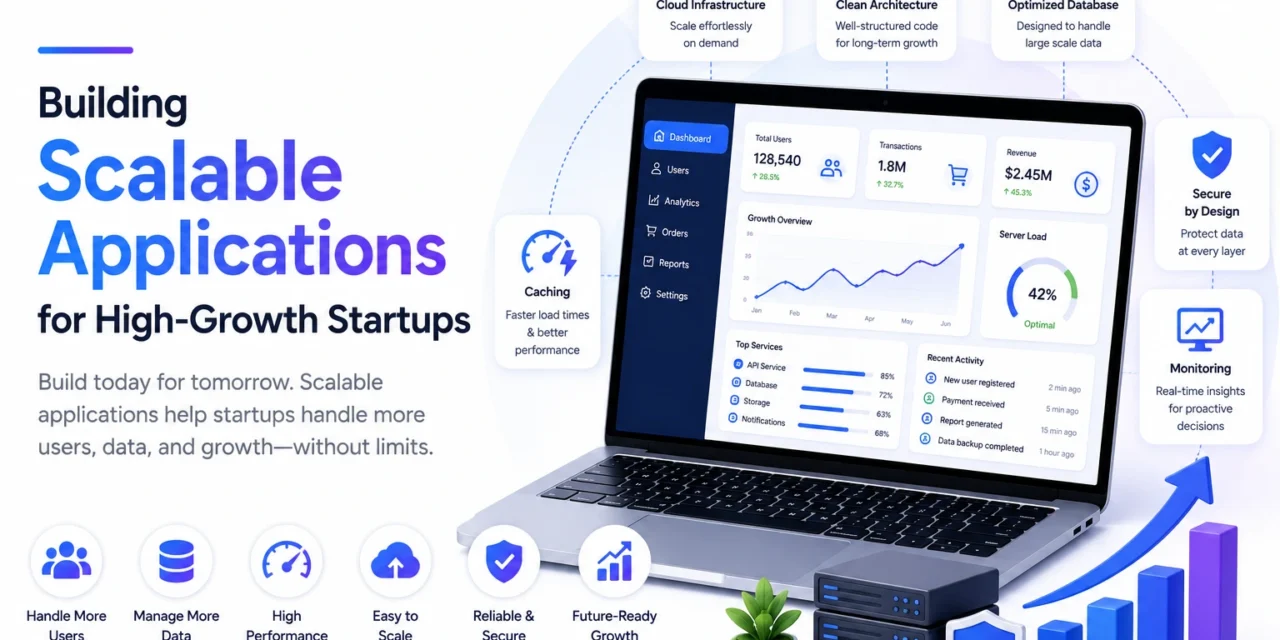
Scalable application development is about building software that can grow with the business. It includes clean architecture, good database design, API planning, caching, background jobs, secure systems, practical infrastructure, and continuous monitoring.
For high-growth startups, scalability is not only a technical goal. It is a business advantage. A scalable product can serve more users, support more features, and handle more opportunities without needing a complete rebuild.
For indie developers, software companies, and internet entrepreneurs, the best approach is to think ahead but build practically. Every successful product starts with a simple idea. When that idea is supported by the right technical foundation, it can grow into useful software that serves real users, creates value, and becomes a strong digital business.