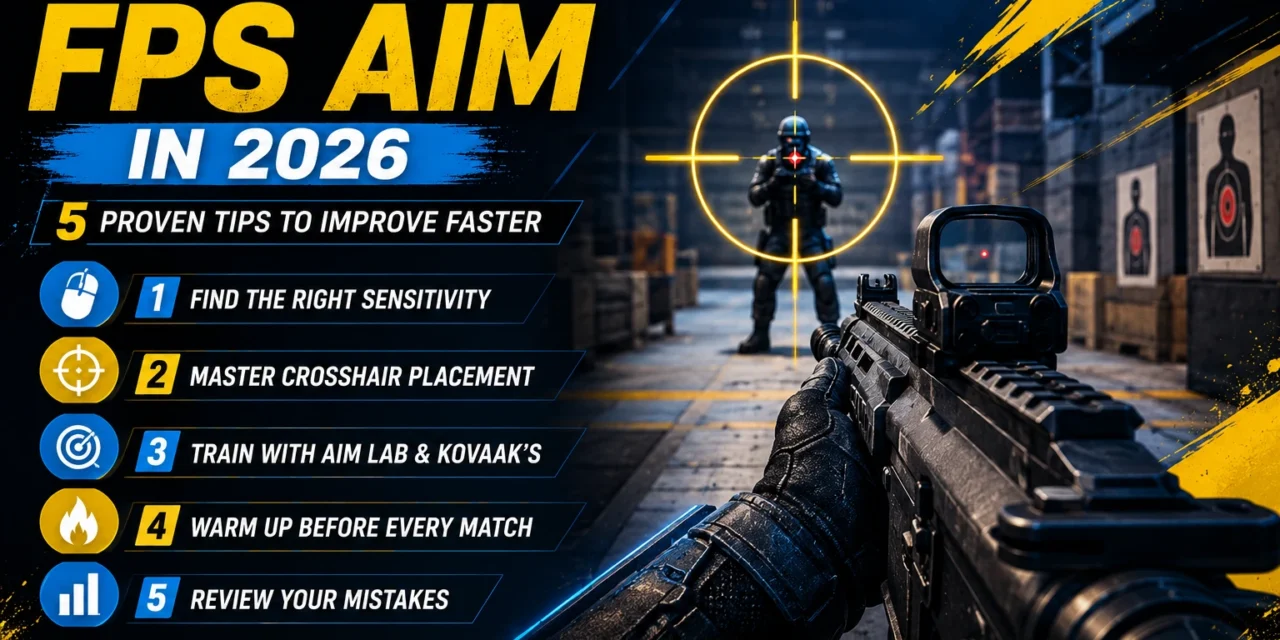
Every FPS player starts the same way – excited to play, frustrated by missing shots that should have connected. The good news is that aim is a trainable skill, not a natural talent you either have or do not have. With the right approach to sensitivity settings, positioning, and deliberate practice, measurable improvement is achievable within two weeks for most players. This guide covers what actually works in 2026, avoiding the advice that sounds good but produces no real results.
Step 1 – Find the Right Sensitivity and Stick With It
The most common beginner mistake is playing on high sensitivity. High sensitivity feels powerful because small movements produce large screen movements, but it makes precise micro-adjustments extremely difficult – the fine motor control required to place a shot on a moving target’s head at range is nearly impossible with a sensitivity setting that moves the crosshair several degrees per millimetre of mouse movement.
A practical starting point for mouse users is 400 DPI on the mouse hardware setting with in-game sensitivity between 0.3 and 0.6 depending on the game. This produces roughly 30 to 40 centimetres of mouse movement to complete a full 360-degree rotation in most games. If you have been playing on higher sensitivity, the transition will feel slow and uncomfortable for approximately one week before your muscle memory adapts. Commit to the change for two weeks before evaluating.
For controller players, lower aim assist strength actually develops better long-term aim than relying heavily on the magnetism effect. Reduce the stick deadzone to the minimum stable setting for your controller and reduce the aim assist from default if the game permits. Short term your aim will worsen noticeably. Within two weeks of deliberate practice your precision will surpass where it was on the higher assist setting.
Step 2 – Master Crosshair Placement Before Anything Else
Crosshair placement – keeping your aim at head height where enemies will appear – is the single highest return-on-investment habit to develop as an early-stage FPS player. Experienced players appear to have faster reactions and sharper aim partly because their crosshair is already near the enemy when the enemy appears, requiring minimal adjustment to connect the shot. The actual mechanical skill required is significantly less than it appears when crosshair placement is working correctly.
Practice crosshair placement deliberately in casual modes before applying it in ranked matches. Walk around a map keeping your crosshair at head height at every corner and doorway, not at floor level where it naturally drifts when moving. This single habit compounds dramatically over time – players who develop good crosshair placement in their first month of serious practice are typically one full skill tier above equivalent players who practiced without this specific focus.
Step 3 – Use Aim Training Software Systematically
- Aim Lab is the best free starting point – available on PC via Steam, it provides hundreds of customisable scenarios covering flicking, tracking, switching targets, and precision with sub-centimetre accuracy. The AI-powered skill assessment identifies your specific weaknesses across aim types and recommends a personalised daily training playlist
- KovaaK’s FPS Aim Trainer is the standard used by professional players for warm-up and deliberate skill development, with thousands of community scenarios including game-specific training routines calibrated to Valorant, CS2, and Apex Legends movement and hitbox characteristics
- In-game practice modes within the actual game you play – the Valorant training range, Apex’s firing range, and CS2’s aim maps all provide game-specific warm-up that transfers directly rather than requiring the player to bridge a gap between generic training and game-specific mechanics
Download Aim Lab free on Steam. Visit www.aimlabs.com. Download KovaaK’s on Steam.
Step 4 – Build a Pre-Session Warm-Up Routine
Playing your first ranked game of the day with cold aim is one of the most avoidable sources of performance inconsistency. Ten to fifteen minutes of aim trainer or deathmatch warm-up before ranked sessions produces measurably better early-session performance that compounds across an entire play session. The habit also creates a psychological transition into competitive mindset that improves focus from the first round rather than needing several games to feel warmed up.
The specific warm-up content matters less than its consistency. If you always do the same routine before playing, your mind and hands develop the muscle memory of what performing well feels like by the time you enter your first ranked game. Pick two or three aim training scenarios you can complete in fifteen minutes and repeat them before every session for thirty days before evaluating their effect.
Step 5 – Analyse Your Deaths Systematically
Most modern FPS games include a kill cam or replay system. Use it systematically after every death in practice sessions rather than skipping directly to the next respawn. After each death, watch how it happened – were you pre-aimed incorrectly? Were you moving when you should have stopped to shoot? Were you caught while reloading? Were you peeking an angle where the enemy had a significant disadvantage with your crosshair position?
The patterns that emerge from ten minutes of deliberate death analysis reveal the specific habits and mistakes that no amount of mechanical aim training addresses. Most deaths in FPS games at beginner and intermediate levels are caused by positioning, game sense, and movement errors rather than mechanical aim failures – understanding this distinction prevents the mistake of spending all improvement effort on aim training when positioning and decision-making are the actual bottlenecks.
Realistic Timeline for Measurable Improvement
With daily practice incorporating the above principles: measurable crosshair placement improvement in one to two weeks. Consistent ranked rank improvement over four to six weeks. A meaningful skill ceiling raise in mechanical aim over three to six months of sustained deliberate practice. Consistency at thirty minutes daily beats intensity at four-hour weekend sessions every time for this type of motor skill development.
The Mental Side of Aim Improvement
Tilt – the emotional state of frustration that follows a string of missed shots or lost rounds – is one of the most significant inhibitors of aim performance and one of the least discussed. In a tilted state, muscle tension increases, movement becomes jerkier, and decision-making quality drops. Developing the habit of taking a ninety-second break and physically relaxing after particularly frustrating moments maintains the calm physical state that accurate aim requires.