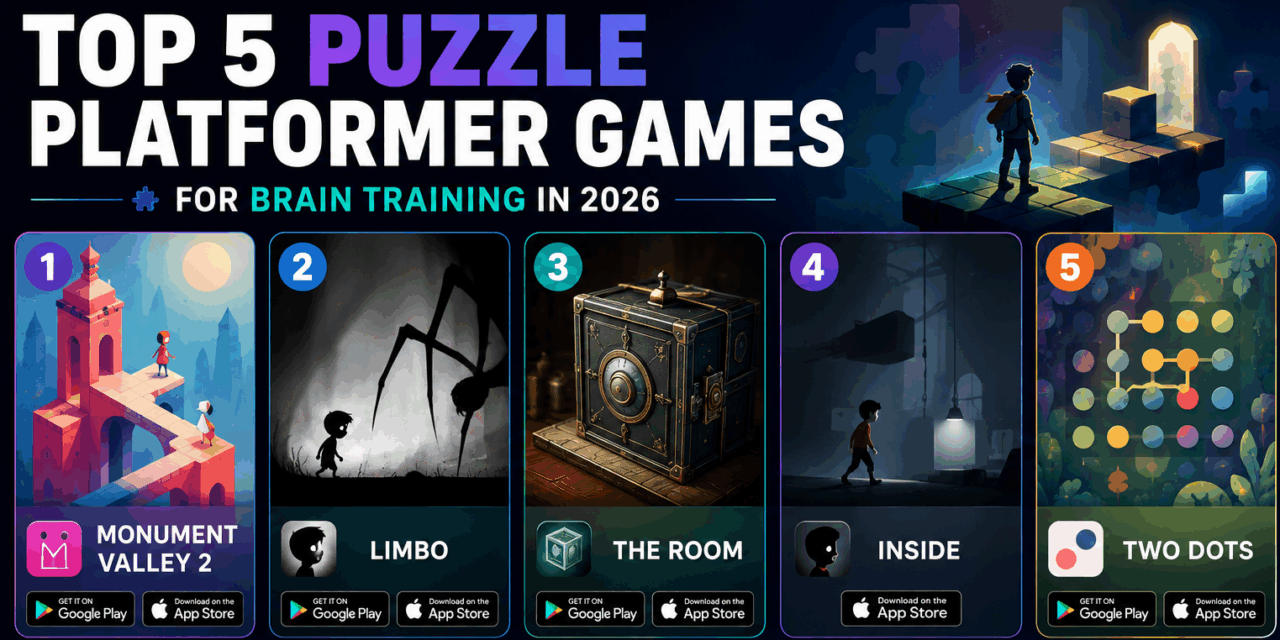
Puzzle platformers occupy a genuinely satisfying middle ground between action and pure logic, asking players to think through spatial problems while still requiring precise timing and control to actually execute the solution. That combination makes them a genuinely good form of brain training, engaging problem-solving, spatial reasoning, and hand-eye coordination simultaneously rather than isolating just one mental skill the way a simple match-three game might. Unlike games that rely purely on reaction speed, the best puzzle platformers reward patience and careful observation just as much as quick reflexes. Here are five puzzle platformer games in 2026 that reward genuine thinking, not just reflexes, and stay engaging well past the first few levels.
Monument Valley 2
Monument Valley 2’s impossible, Escher-inspired architecture turns perspective itself into the core puzzle mechanic, requiring players to rotate and reshape structures to find paths that shouldn’t logically exist. Its mother-daughter narrative adds emotional weight rarely found in the puzzle genre, and its short length makes it a satisfying complete experience rather than an endless grind.
Limbo
Limbo strips puzzle platforming down to stark black-and-white visuals and unforgiving trial-and-error mechanics, where every screen hides a genuine threat requiring careful observation before acting. Its atmospheric tension makes even simple physics puzzles feel genuinely tense rather than routine.
The Room
The Room series turns intricate mechanical puzzle boxes into a full game, rewarding close observation and methodical experimentation over quick reflexes. Its tactile, satisfying puzzle design has made it one of the most consistently praised mobile puzzle franchises for anyone who enjoys genuinely intricate mechanisms.
INSIDE
INSIDE builds on Limbo’s atmospheric formula with more elaborate environmental puzzles and a genuinely unsettling narrative that unfolds almost entirely without dialogue. Its puzzles integrate seamlessly into the platforming itself, rather than feeling like separate obstacles interrupting the flow of movement.
Two Dots
Two Dots blends connect-the-dots puzzle mechanics with light platformer-style level progression and genuinely clever twists introduced gradually across hundreds of levels, keeping the core simple mechanic from ever feeling stale thanks to constantly shifting constraints and objectives.
Why Puzzle Platformers Make Genuinely Good Brain Training
Unlike dedicated brain-training apps that isolate a single cognitive skill through repetitive drills, puzzle platformers engage multiple types of thinking simultaneously, spatial reasoning to understand a level’s geometry, working memory to track what you’ve already tried, and motor planning to actually execute a solution under time pressure. That combination more closely mirrors how problem-solving works in real life, where you rarely get to isolate just one mental skill at a time. The genre also tends to avoid the repetitive, grinding feel of dedicated brain-training apps, since each new level or environment introduces a genuinely fresh problem rather than a slightly harder version of the same drill you’ve already mastered. That variety is a big part of why puzzle platformers tend to hold player attention far longer than apps explicitly marketed as brain training tools ever manage to.
Whether you want atmospheric tension, physical puzzle boxes, or impossible architecture to untangle, this genre offers some of the most genuinely satisfying mental workouts available on mobile without ever feeling like homework. Start with Monument Valley 2 if you want something visually stunning and emotionally resonant, or The Room if you prefer methodical, mechanical puzzle-solving without a heavier narrative attached. Either way, give each level a genuine few minutes of thought before searching for a walkthrough, the satisfaction of solving it yourself is a big part of what makes this genre so rewarding in the first place.