The smartwatch market matured significantly in 2026. Every major option now offers accurate heart rate monitoring, sleep tracking, and fitness modes as baseline features. The differentiators have shifted to health measurement depth, ecosystem integration, battery life, and design quality. This ranked guide covers the best options across every budget and use case from casual fitness tracking to serious athletic training.
-
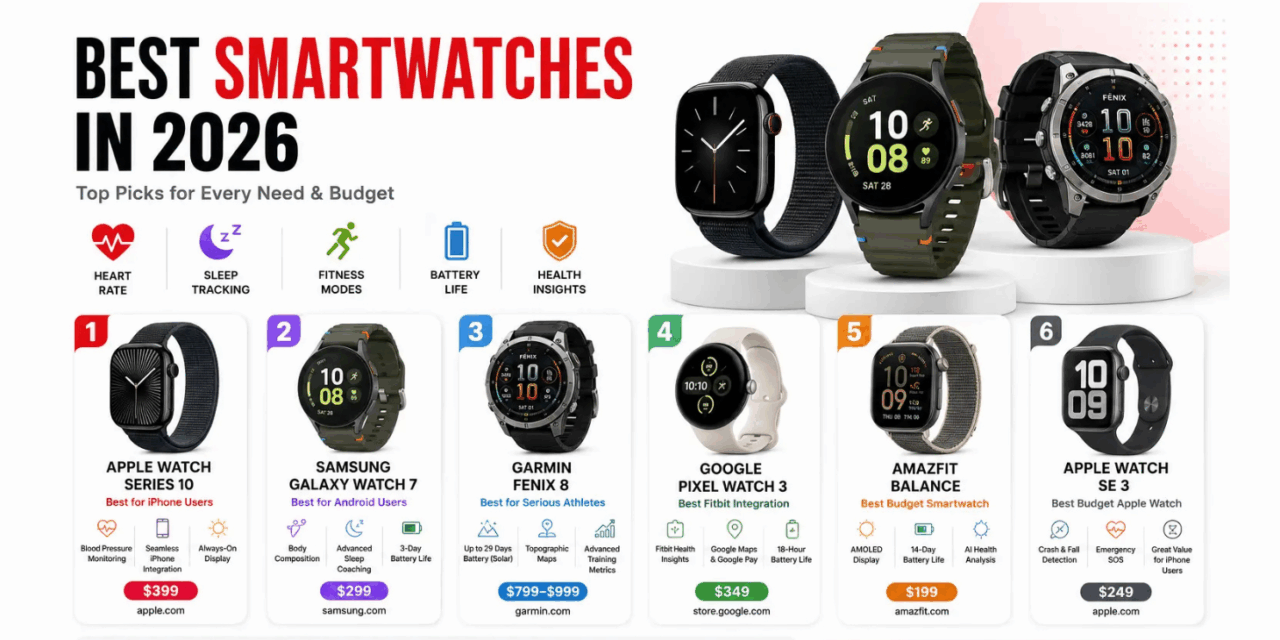
Apple Watch Series 10 – Best for iPhone Users
The thinnest Apple Watch ever produced, with the new blood pressure monitoring feature that received FDA clearance in early 2026. The health suite on Series 10 is the most complete on any Apple Watch – ECG, blood oxygen, body temperature, crash detection, fall detection, and now blood pressure trend monitoring all in a single device.
The integration with iPhone is the tightest in the smartwatch category. Handoff between iPhone and Watch for calls and notifications is seamless. The Apple Fitness Plus integration gives structured workouts that adapt to your Apple Watch health data. The Always-On Display brightness has improved significantly for outdoor readability in 2026.
Available at www.apple.com from three hundred and ninety-nine dollars.
-
Samsung Galaxy Watch 7 – Best for Android Users
The Galaxy Watch 7 has the most complete health tracking suite on any Android-compatible smartwatch in 2026. Body composition analysis using bioelectrical impedance measures muscle mass, body fat percentage, and body water distribution directly from the watch. The Advanced Sleep Coaching feature analyses your sleep patterns over multiple weeks and provides specific behaviour recommendations rather than just reporting metrics.
The new Snapdragon W5 Plus chip makes the Galaxy Watch 7 noticeably faster than its predecessor for UI navigation and app loading. The three-day battery life on a single charge is consistent with Samsung’s claim in real-world testing with the always-on display enabled.
Available at www.samsung.com from two hundred and ninety-nine dollars.

-
Garmin Fenix 8 – Best for Serious Athletes
The Garmin Fenix 8 is the gold standard for sports and fitness smartwatches in 2026. The solar charging variant achieves up to twenty-nine days of battery life in smartwatch mode, making it genuinely wearable for extended expeditions and ultra-endurance events where charging access is limited. The training metrics go deeper than any other consumer smartwatch – Training Readiness, HRV Status, Body Battery, acute load versus chronic load ratio, and performance condition during workouts.
The built-in topographic maps with turn-by-turn navigation are genuine trail navigation tools rather than simplified walking directions. For runners, cyclists, hikers, and triathletes who want a device that takes their training as seriously as they do, nothing in the consumer market matches the Fenix 8.
Available at www.garmin.com from seven hundred and ninety-nine to nine hundred and ninety-nine dollars depending on model variant.
-
Google Pixel Watch 3 – Best Fitbit Integration
The Google Pixel Watch 3 represents the most complete integration of Google’s Fitbit health data platform with a modern smartwatch design. The Fitbit algorithms – some of the most validated consumer health tracking algorithms available – power the sleep analysis, stress detection, and cardio fitness score features. For Android users who have existing Fitbit data history, the continuity of that data in the Pixel Watch 3 ecosystem is a meaningful advantage.
Google Maps navigation works natively on the watch with turn-by-turn directions and live transit information. Google Pay contactless payments are supported on the watch without needing the phone. The battery life of around eighteen hours with continuous heart rate tracking is the weakest point compared to the Samsung and Garmin options.
Available at store.google.com from three hundred and forty-nine dollars.
-
Amazfit Balance – Best Budget Smartwatch in 2026
The Amazfit Balance at one hundred and ninety-nine dollars delivers health tracking that competes with watches at twice its price in several specific areas. The AMOLED display is bright and clear, the heart rate monitoring accuracy is genuinely good, and the fourteen-day battery life is the best in this price range. The Zepp OS 3.0 operating system in 2026 supports third-party app installation and improved AI health analysis.
The trade-off at this price is ecosystem depth. Amazfit does not integrate as seamlessly with iOS or Android as Apple Watch or Galaxy Watch respectively, and third-party app support is more limited. For users who primarily want health and fitness tracking without caring about smartphone notification management or app ecosystems, the Balance delivers exceptional value.
Available at www.amazfit.com and major electronics retailers globally.
-
Apple Watch SE 3 – Best Budget Apple Watch
For iPhone users who want Apple Watch integration without the full Series 10 price, the Apple Watch SE 3 at two hundred and forty-nine dollars provides the core Apple Watch experience including fall detection, crash detection, emergency SOS, and Apple Watch’s native app ecosystem. It lacks the ECG, blood oxygen sensor, and always-on display of the Series 10, but for most everyday users these omissions are acceptable trade-offs for the price difference.
Available at www.apple.com from two hundred and forty-nine dollars.
How to Choose the Right Smartwatch in 2026
The right smartwatch depends primarily on your smartphone ecosystem. iPhone users should choose Apple Watch – the integration advantages make it the clear choice regardless of the specific model. Android users get the best experience from Galaxy Watch on Samsung phones and Pixel Watch 3 on Google Pixel phones. For serious athletes regardless of phone platform, Garmin’s training ecosystem depth makes it the performance choice. For budget buyers, Amazfit Balance delivers the most health tracking value per dollar of any option in 2026.