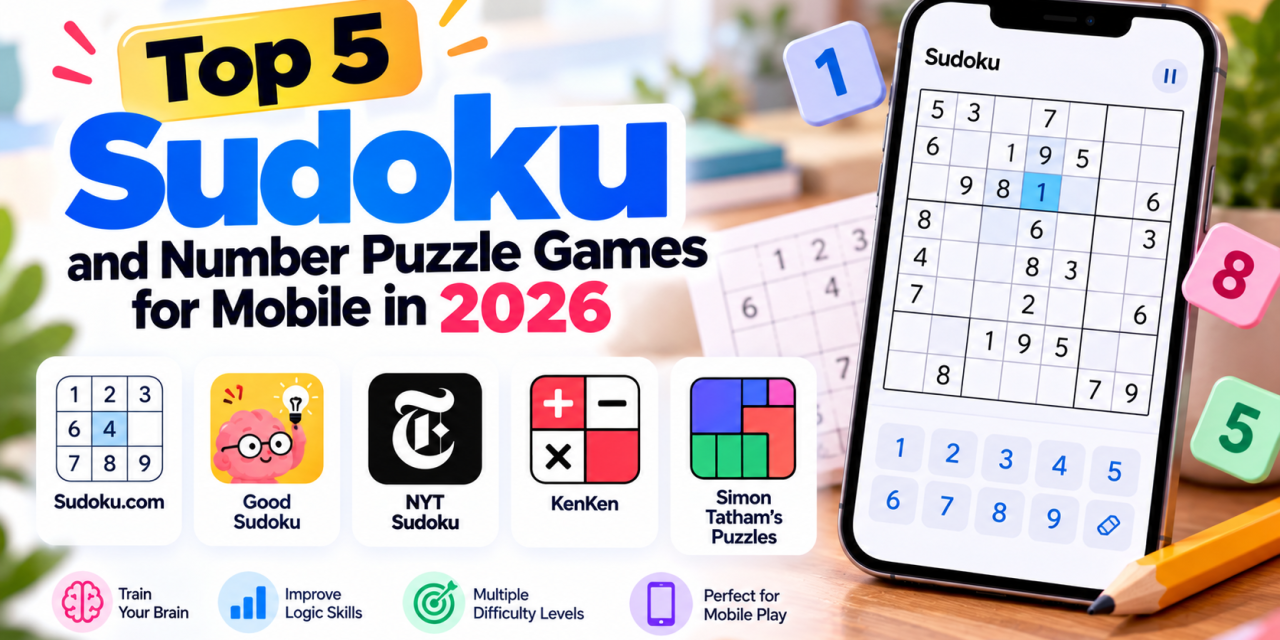
Sudoku and its many number-based puzzle relatives remain one of mobile gaming’s most durable, screen-time-friendly genres, offering genuine logic training without any of the twitch reflexes or steep learning curve a typical mobile game demands. The category’s commercial staying power is genuinely notable too: Easybrain, the studio behind Sudoku.com, was acquired by Stillfront Group for $640 million in 2021, a striking valuation for what began as a humble digital number puzzle. Here are five worth downloading this year.
Sudoku.com

Sudoku.com remains the most popular sudoku app by a genuinely wide margin, offering an enormous library of puzzles across six difficulty levels alongside daily challenges, seasonal events, a number highlight function, a hint system, and unlimited undo for anyone who wants to freely experiment with a specific move. Its clean, polished design and consistently updated content have made it the default recommendation for casual sudoku players, and its statistics tracking gives dedicated players a genuine sense of improvement over time. For anyone wanting the single most complete, actively maintained sudoku experience available, it remains the clearest starting point.
Good Sudoku
Good Sudoku, from acclaimed puzzle designer Zach Gage, takes a genuinely distinctive approach by teaching actual sudoku-solving techniques rather than simply presenting a grid to fill in, with a hint system that reveals the logical path to a solution instead of just handing over a number. This educational focus makes it the clear pick specifically for players who want to genuinely get better at sudoku’s underlying logical techniques rather than just filling in numbers through trial and error. For players who want real skill development alongside the puzzle itself, it remains one of the most thoughtfully designed sudoku apps available.
NYT Sudoku

NYT Sudoku, part of the New York Times Games app alongside Wordle, Connections, and Spelling Bee, offers three daily puzzles ranging from easy to hard, fitting naturally into the same daily gaming ritual players already have established with the Times’s other popular word games. For players already subscribed to NYT Games for its other daily puzzles, adding sudoku to that same existing habit requires no additional app or separate subscription to manage. For anyone already embedded in the NYT Games ecosystem, it remains a genuinely natural, low-friction addition to an existing daily routine.
KenKen
KenKen combines sudoku-style unique-number placement with genuine arithmetic operations, requiring groups of cells to satisfy specific mathematical equations using addition, subtraction, multiplication, or division alongside the standard row-and-column uniqueness rule. This blend of logical deduction and actual mental math gives it a genuinely different cognitive workout than pure sudoku, appealing specifically to players who want their number puzzle to exercise arithmetic skill alongside pure logic. For players who find standard sudoku alone insufficiently challenging, it remains one of the more mentally demanding number puzzle formats available.
Simon Tatham’s Puzzles

Simon Tatham’s Puzzles offers a genuinely remarkable collection of more than 40 procedurally generated logic puzzles, including sudoku, minesweeper, and mastermind under different names alongside dozens of less familiar logic puzzle types, all completely free of ads, in-app purchases, and any account requirement whatsoever. Its fully offline functionality and tiny under-10MB size make it genuinely accessible even on older or storage-constrained devices, and every puzzle type offers fully adjustable difficulty and grid size for infinite replayability. For puzzle enthusiasts who specifically want infinite variety with zero monetization pressure of any kind, it remains one of the purest, most respected options in the entire category.
What separates these five most is teaching depth and puzzle variety rather than any single shared sudoku formula. Players who want the most complete, actively maintained standard sudoku experience should start with Sudoku.com, while anyone who wants to genuinely improve their logical solving technique rather than just filling in numbers will get more out of Good Sudoku’s teaching-focused hint system. NYT Sudoku fits naturally into an existing NYT Games habit, KenKen adds genuine arithmetic challenge beyond pure logic, and Simon Tatham’s Puzzles offers the widest variety of logic puzzle types with zero monetization pressure whatsoever.
Conclusion
Sudoku and number puzzle games continue to prove that genuine logical satisfaction remains one of mobile gaming’s most consistently rewarding and screen-time-friendly formats, a fact reflected in the genuinely striking commercial valuations this humble genre has attracted. Whether the pull is Sudoku.com’s polished completeness, Good Sudoku’s genuine skill teaching, or KenKen’s added arithmetic challenge, this year’s top five number puzzle games each deliver real, satisfying mental exercise.