
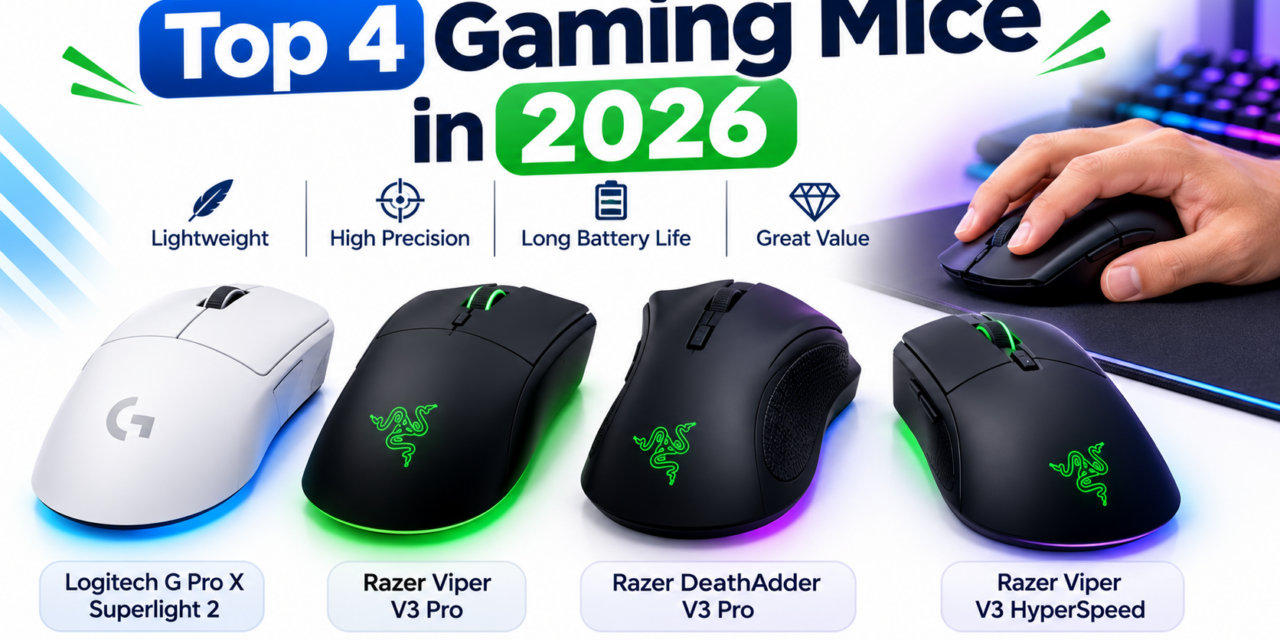
The best gaming mouse is mostly about fit. Sensor quality has become excellent across the board, so differences now come down to weight, shape, grip style, battery life, and price. Competitive players favor ultralight mice, often around 50 to 60 grams, because they are easier to flick and stop. Others prefer a heavier, curved shape for comfort over long sessions. Polling rate, how often the mouse reports its position, now reaches 8,000 hertz on some models, though that needs a compatible receiver and a capable PC to matter. New models appear constantly, and Razer and Logitech have already released newer flagships than some of those below, so treat prices as indicative. Availability and warranty differ by country, so confirm local stock. Here are four strong choices.
Logitech G Pro X Superlight 2
The Logitech G Pro X Superlight 2 is widely named the best all-round wireless gaming mouse. It weighs about 60 grams with no holes in the shell, uses Logitech’s HERO 2 sensor rated up to 44,000 DPI, supports 8,000 hertz polling with the right receiver, and lasts roughly 95 hours on a charge. Its safe, symmetrical shape suits claw and fingertip grips and feels familiar to anyone who has used a Logitech mouse. It is expensive, commonly around 140 to 160 dollars, and its lack of extra buttons suits shooters more than MMO play. For competitive players who want a dependable, refined mouse, it is the safest recommendation.
Razer Viper V3 Pro
The Razer Viper V3 Pro is the esports favorite and is often called the consensus pick at several review outlets. It weighs around 54 grams, uses Razer’s Focus Pro 35K sensor, supports 8,000 hertz polling, and offers a flatter, symmetrical shape that suits claw and fingertip grips. Battery life is around 95 hours. Its lighter weight appeals to players who find 60 grams still heavy. It costs roughly the same as the Logitech, so the decision usually comes down to shape and software preference. Razer has since released newer models, so older stock may be discounted. For fast-paced shooters, it is a top-tier choice.
Razer DeathAdder V3 Pro
The Razer DeathAdder V3 Pro is the ergonomic pick. Its right-handed, curved shape has been a favorite for palm and relaxed claw grips for years, and the V3 Pro trims the weight to about 63 grams while adding a modern sensor and wireless connection. It is more comfortable than a symmetrical mouse for many hands over long sessions, though it is not suitable for left-handed users. It costs about as much as the other flagships, and Razer has released a newer DeathAdder V4 Pro as well. For players who prioritize comfort in long gaming sessions, it is the strongest choice.
Razer Viper V3 HyperSpeed
The Razer Viper V3 HyperSpeed is the value pick, widely described as the best wireless gaming mouse under about 100 dollars, often priced near 70 dollars. It uses a single AA battery for roughly 280 hours of use and supports polling up to 4,000 hertz, with a Focus Pro 30K sensor. The trade-off is weight: at around 82 grams with the battery it is much heavier than the flagships, which some players dislike. It is a very good first wireless mouse for anyone who does not want to spend premium prices. For budget buyers, it delivers most of the performance for far less money.
Budget shoppers can also consider the Logitech G305, a long-lived, inexpensive wireless mouse with a battery that lasts for months, and enthusiasts often look at the Pulsar X2 series and Lamzu models for very low weights. Choosing among the main four comes down to grip and budget. Claw and fingertip players who want a safe pick should try the Logitech G Pro X Superlight 2, while those who prefer a flatter, lighter shape should look at the Razer Viper V3 Pro. Palm-grip players should consider the DeathAdder V3 Pro, and buyers on a budget will be well served by the Viper V3 HyperSpeed. Measure your hand and note your grip before buying, check the return policy, and use a good mousepad, since the surface affects tracking more than most specifications.
Conclusion
A great mouse is one you stop noticing, and the right one depends on your hand, grip, and games more than on a spec sheet. Match the shape and weight to how you play, check warranty and stock where you live, and let a quick return policy back up your choice.