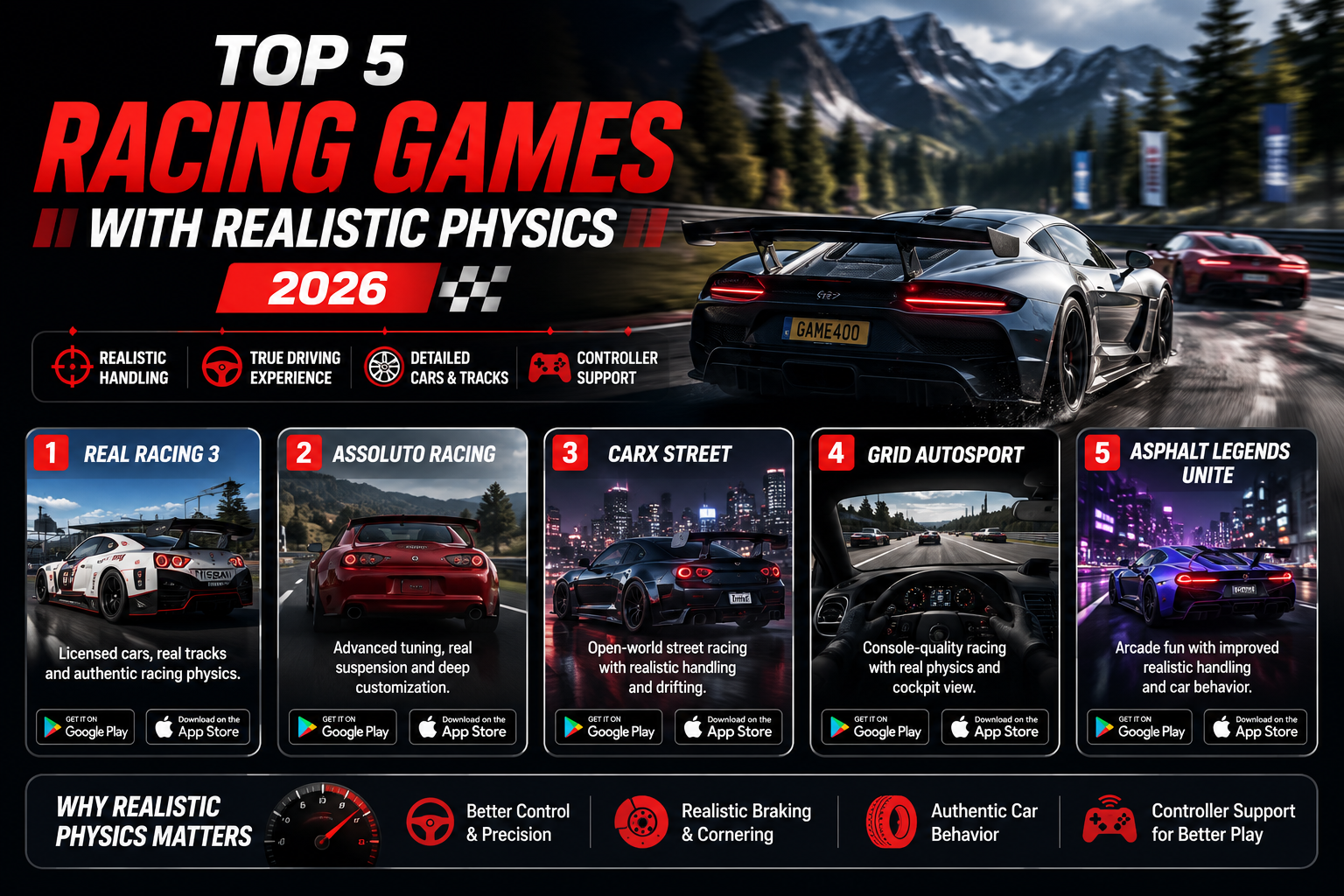
Arcade racers will always have their place, but there’s a specific kind of satisfaction in a racing game where weight transfer, tire grip, and braking distance actually matter to how you drive. Realistic physics racers reward practice and car control instead of just memorizing drift boost timing, and mobile hardware has finally caught up enough to render that kind of simulation convincingly on a phone. The genre used to be a rough compromise on mobile, with touch controls fighting against genuinely complex physics models, but recent titles have found a much better balance between depth and playability. Here are five racing games in 2026 that take physics seriously without sacrificing accessibility for players who don’t own a racing wheel.
Real Racing 3
Real Racing 3 has stayed the benchmark for realistic mobile racing for years, with genuine manufacturer-licensed cars and tracks that respond convincingly to braking and cornering mistakes. Its career mode remains deep enough to keep serious racing fans engaged for dozens of hours without repeating content.
Assoluto Racing
Assoluto Racing leans further into simulation than most mobile racers, with a tuning system that lets players adjust suspension, gearing, and tire pressure in genuine depth. It’s a strong pick for players who want the tinkering side of racing sims, not just the driving.
CarX Street
CarX Street builds on CarX’s well-regarded physics engine with an open-world street racing setting, blending realistic handling with a more freeform exploration layer than track-only racers offer. Drift mechanics in particular feel noticeably more grounded than typical arcade drift systems.
GRID Autosport
GRID Autosport brought a genuine console-quality racing sim to mobile, with proper cockpit views and a handling model that punishes careless cornering more than most competitors in this list. It’s a paid title, but the depth on offer reflects that upfront pricing.
Asphalt Legends Unite
Asphalt sits closer to arcade than pure simulation, but recent entries have added more weighty handling and realistic car behavior compared to earlier games in the series, making it a good middle ground for players easing into more serious racing physics.
Controller Support Makes a Real Difference
Touchscreen steering can only get you so far in a genuinely physics-driven racer, and most of the games on this list support Bluetooth controllers, which noticeably improves precision during braking and mid-corner corrections. If you’re serious about this genre, a basic mobile controller clip is a worthwhile investment, the difference in lap times alone tends to justify the cost within the first few sessions. Screen size matters too, larger tablets make it considerably easier to judge braking points and apex timing compared to squinting at a small phone display during a tight race.
Realistic physics racers ask more of the player than arcade titles, but that’s exactly the appeal for a specific kind of racing fan who wants mistakes to feel earned rather than randomly generated. Real Racing 3 remains the safest starting point for most players thanks to its free-to-play accessibility and content depth, while Assoluto Racing and GRID Autosport reward players who want to go further into genuine tuning and simulation. Whichever you pick, give yourself a few sessions to adjust before judging the handling, physics-based racers almost always feel awkward for the first hour before your muscle memory catches up to how the car actually behaves. Most of these also support periodic content updates with new cars and tracks, so it’s worth checking back every few months even after you’ve settled on a favorite